
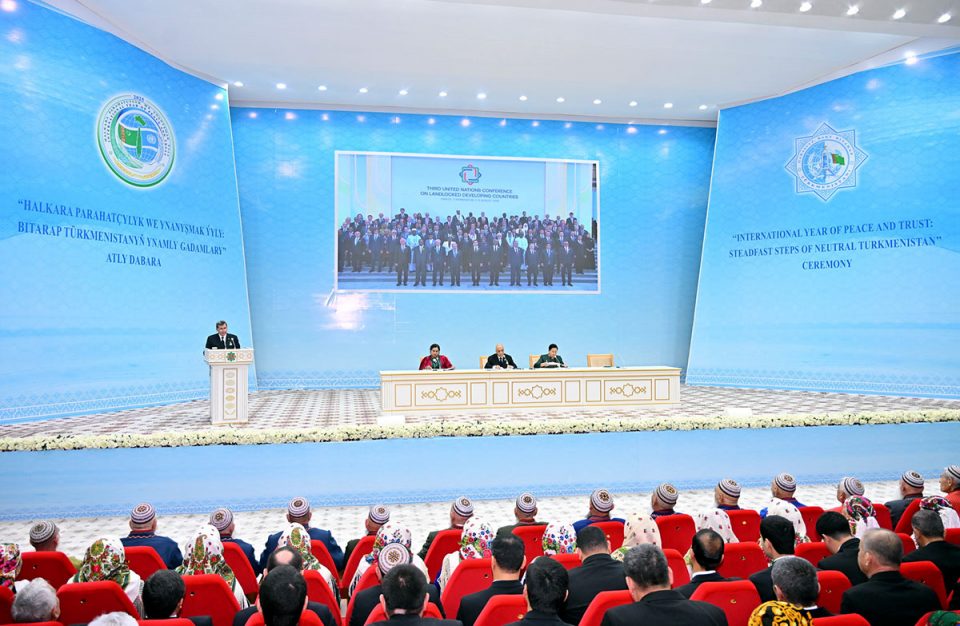
At the ceremony “International Year of Peace and Trust: Confident Steps of Neutral Turkmenistan,” organized by the Halk Maslahaty of Turkmenistan in Ashgabat on 25 Dec 2025, Deputy Chairman of the Cabinet of Ministers and Minister of Foreign Affairs Rashid Meredov delivered a keynote speech.
The Minister emphasized that 2025 has become a landmark year in the history of modern Turkmenistan, marking significant progress in strengthening the principles of statehood, political, economic, and social development. These achievements, he noted, are the result of the extensive efforts of the National Leader of the Turkmen people, Chairman of the Halk Maslahaty, Hero-Arkadag Gurbanguly Berdimuhamedov, and President Serdar Berdimuhamedov.
Meredov highlighted that the wide celebration of the 30th anniversary of Turkmenistan’s permanent neutrality coincided with two other major milestones: the International Year of Peace and Trust, proclaimed by the UN General Assembly on Turkmenistan’s initiative, and the 80th anniversary of the founding of the United Nations. These events are interconnected and carry profound practical significance.
In the outgoing year, Turkmenistan reaffirmed its unwavering commitment to the principles of permanent neutrality, international law, and the UN Charter, while actively promoting a culture of peace and trust.
The philosophy of Turkmenistan’s development as a responsible member of the international community is based on three interrelated principles: neutrality, peace, and trust, the Minister stressed.
“Today, we can confidently state that tremendous work has been done to promote neutrality as the foundation of peacemaking and political dialogue in addressing complex issues. As a result, the world has come to better recognize the importance of our neutrality and its role as a key factor in security, peace, and sustainable development,” the head of Turkmenistan’s foreign ministry continued.
Hundreds of events dedicated to the International Year of Peace and Trust were held both in Turkmenistan and abroad, with a focus on explaining the essence of Turkmen neutrality in the media, expert circles, and academic communities.
The UN General Assembly unanimously adopted several resolutions initiated by Turkmenistan, including one reaffirming the country’s permanent neutrality status, as well as documents on energy and transport.
On December 15, 2025, the General Assembly adopted the resolutions “The Key Role of Reliable and Stable Energy Connectivity in Achieving Sustainable Development” and “United Nations Decade on Sustainable Transport (2026–2035)”, Meredov told.
These documents provide an analysis of ongoing work in sustainable energy and transport, and outline specific measures for advancing these sectors through specialized UN working groups, including those established on Turkmenistan’s initiative.
Thus, the resolutions adopted on 15 December have become a solid political and legal foundation for continued international cooperation in ensuring sustainable energy and transport connectivity at national, regional, and global levels, as well as for building an efficient international energy and transport infrastructure.
Meredov spoke about Turkmenistan’s active engagement in international organizations and regional formats, including support for the proposal to invite Azerbaijan as a full member to the Consultative Meetings of Central Asian Heads of State, and participation in “Central Asia +” dialogues (with partners such as China, Russia, the United States, Japan, the European Union, and Italy).
Intensive bilateral contacts were evidenced by 15 foreign visits by President Serdar Berdimuhamedov, 9 visits by the National Leader, and visits to Turkmenistan by heads of state from 31 countries.
Key events of the year included major international forums hosted by Turkmenistan, such as the Third UN Conference on Landlocked Developing Countries, the International Conference on the Role of Women in Achieving the Sustainable Development Goals, and the International Forum marking the neutrality anniversary, which concluded with the adoption of the Ashgabat Declaration.
Foreign minister particularly focused on the Turkmen model of neutrality, which is gaining global significance as a factor in bringing nations closer together and achieving consensus.
“Our country has demonstrated to the international community that neutrality is not merely an official status of a single state. Neutrality is a special attitude toward oneself and toward other peoples as a whole—as one human family. Despite emerging challenges, peace, harmony, and respect must prevail in such a family,” he said.
Through its consistent actions, Turkmenistan has demonstrated a steadfast commitment to leveraging its neutral status for the global good. By aligning its foreign policy with the principles of humanism, the nation serves as a catalyst for international development and the collective well-being of all states and peoples.
From this perspective, neutrality has a bright future. In line with its unique nature, it aims to become an essential political and legal tool for cooperation aimed at rapprochement, consensus-building, and respect for legitimate interests.
“Turkmenistan is convinced that the opportunities inherent in neutrality, along with its tools and approaches, will be widely and frequently used in international politics, especially in specific situations. Neutrality has been and will remain the guiding principle of the country’s internal development and international cooperation,” emphasized the DPM.
The unwavering public mandate for the neutral course was solidified in 2025 with the adoption of the Constitutional Law ‘On the Legal Foundations of the Policy of Peace and Trust of Neutral Turkmenistan.’
Moving forward, Turkmenistan remains commited to the pillars of neutrality, peace, and trust. These principles serve as the bedrock of a foreign policy dedicated to cultivating friendship, good-neighborly relations, and constructive cooperation with the global community.
In his closing remarks, Meredov affirmed that Turkmenistan has every prerequisite for continued success, including strong statehood, respect and recognition on the global stage, clear goals, and objectives.