
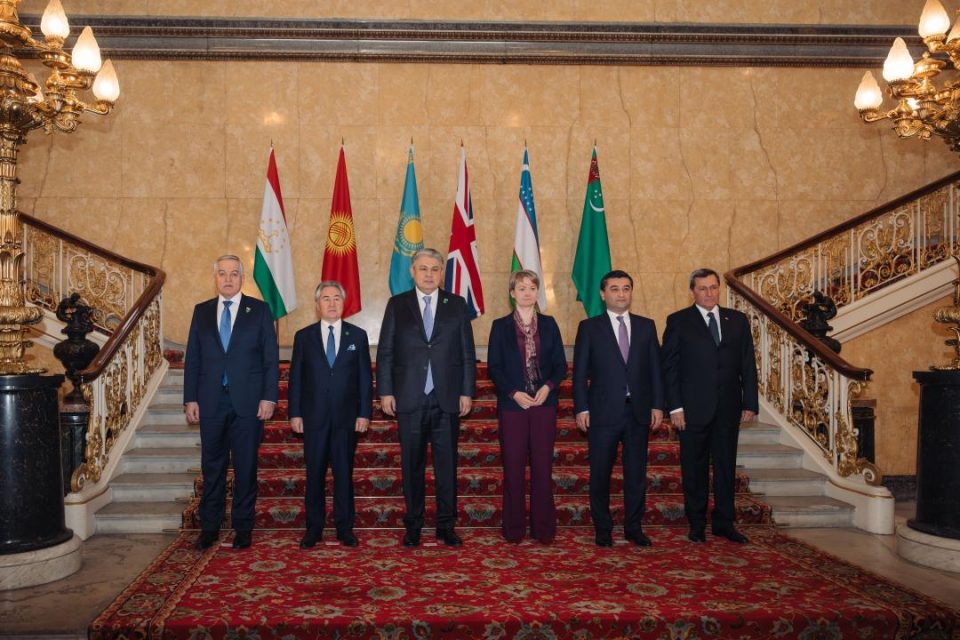
At the invitation of the British side, the Deputy Chairman of the Cabinet of Ministers and Minister of Foreign Affairs of Turkmenistan, Rashid Meredov, participated in a meeting of the heads of foreign affairs agencies of Central Asian countries and the United Kingdom within the framework of the “Central Asia + United Kingdom” (C5+UK) format.
The meeting was also attended by:
-
Yvette Cooper, Secretary of State for Foreign, Commonwealth and Development Affairs of the United Kingdom;
-
Yermek Kosherbayev, Minister of Foreign Affairs of the Republic of Kazakhstan;
-
Zheenbek Kulubaev, Minister of Foreign Affairs of the Kyrgyz Republic;
-
Bakhtiyor Saidov, Minister of Foreign Affairs of the Republic of Uzbekistan.
The parties discussed a wide range of issues on the bilateral and regional agendas, opportunities for economic growth, increasing trade and investment cooperation, as well as joint efforts to support regional connectivity and the development of international transport routes.
In her speech, UK Foreign Secretary Yvette Cooper emphasized the special importance of Central Asia as a dynamically developing region with steady rates of economic growth, strengthening regional cooperation, and a growing role in international affairs. It was noted that the countries of the region demonstrate a pragmatic approach in mutual relations, strengthening connectivity, and consistently expanding their involvement in the formation of a modern structure for economic and political cooperation.
Special attention was paid to the realization of synergy between Central Asia’s resource and transit potential and the United Kingdom’s capabilities in the fields of finance, regulatory standards, technology, and education.
In turn, the Foreign Ministers of Central Asia highly praised the “C5+UK” format as an important form of interaction between the United Kingdom and the Central Asian states. It was noted that this format has already proven itself to be an effective mechanism for establishing structured and meaningful dialogues with external partners.
It allows for a comprehensive look at the regional agenda, taking into account the common interests and priorities of Central Asian countries, while also creating additional opportunities for promoting economic initiatives and implementing joint projects.