
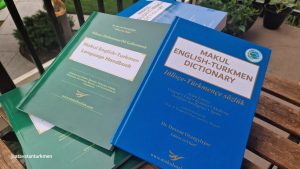
As well known, the “Makul English-Turkmen” language handbook was recently prepared and published in the United States of America, and has also been put up for sale on the world-famous “Amazon” platform.
We bring to your attention the remarks of Professor Yusuf Azmun—a linguist, literary scholar, and laureate of the Magtymguly State Prize of Turkmenistan—who contributed the foreword regarding the significance of this new work:
Completion of a good dictionary requires careful planning. The making of good dictionaries also requires, among other things, the study of word structure, which makes the study of a language more practical and useful. A good dictionary is an effective means of studying word etymology. It gives the derivation of each word and, when needed, explains the affixes, which are essential in the study of vocabulary. A good dictionary should also be easy to read, offering useful aspects of the language with clear explanations. These qualities make a dictionary crucial for learning. It must be accurate and authoritative, reflecting how language is actually used. Information about the structure of words also constitutes an essential part of good dictionaries.
These properties were clearly present in the previously published Makul English–Turkmen Dictionary, which made an important contribution to Turkmen-English lexicography. That volume functioned primarily as a dictionary, presenting English words together with their Turkmen equivalents and grammatical classifications, thereby providing a reliable lexical foundation for learners and translators.
The present volume, the Makul English-Turkmen Language Handbook, is not merely a continuation but a complementary expansion of that earlier work. While the first book focused on vocabulary and lexical reference, this handbook broadens the scope by addressing structural and functional components of the English language that are essential for learners.
For many years, Turkmen learners have had limited access to comprehensive English reference materials. The Makul project has sought to fill this gap by offering structured and accessible resources. This handbook brings together the fundamental components necessary for mastering English.
It introduces readers to English prefixes, which help clarify word formation and meaning. It explains irregular verbs-an area that often presents difficulty for learners. In addition, it covers idioms, phrasal verbs, suffixes, and root words, all of which are essential for deeper linguistic understanding. The inclusion of contextual examples strengthens practical comprehension. The section on conversational English, if expanded further, could easily stand as an independent volume.
This book is an important publication. Turkmen learners of English will benefit greatly from it. Moreover, it can confidently be said that this work will serve not only those who wish to learn English, but also as a valuable guide for those who wish to learn the Turkmen language.
I congratulate the author and the Makul Group on producing such a useful and historically significant scholarly work, and on continuing their contribution to the development of English–Turkmen linguistic studies. I also encourage the Makul Group to continue their project of serving as an important linguistic bridge between the English and Turkmen languages.
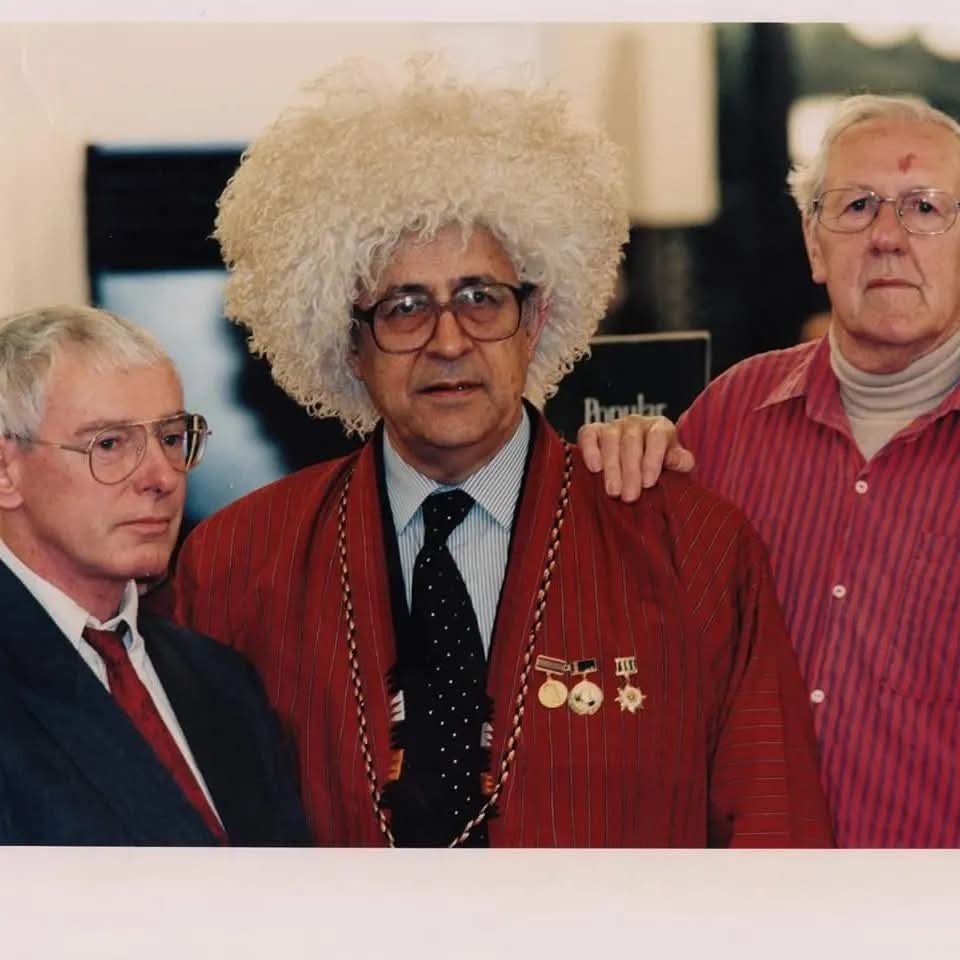
Biography
Professor Yusup Azmun is a distinguished linguist, literary scholar, and creative intellectual who has made an immense contribution to the global recognition and scholarly study of the Turkmen language. He devoted his life to exploring the phonetic structure, lexicon, and morphology of the Turkmen language, as well as the linguistic foundations of Turkmen folklore. His research on “The Phonetic Structure of the Turkmen Language,” “Dede Gorkut,” and the works of Magtymguly Pyragy has been highly acclaimed by the international academic community.
Born in 1939, Professor Azmun is the author of dozens of scholarly books, hundreds of articles, and numerous translations. He has carried out academic work for many years in Turkey, the United Kingdom, the United States, and other countries. He is not only a scholar but also a cultural ambassador who has introduced the classical values of the Turkmen language to the global community.
For his exceptional contributions to the national culture and linguistic heritage of the Turkmen people, Professor Yusup Azmun has been honored with Turkmenistan’s Magtymguly State Literature Award and Turkey’s Honorary Award of the Turkish Language Association. His academic and creative legacy continues to inspire the younger generation of Turkmens.