
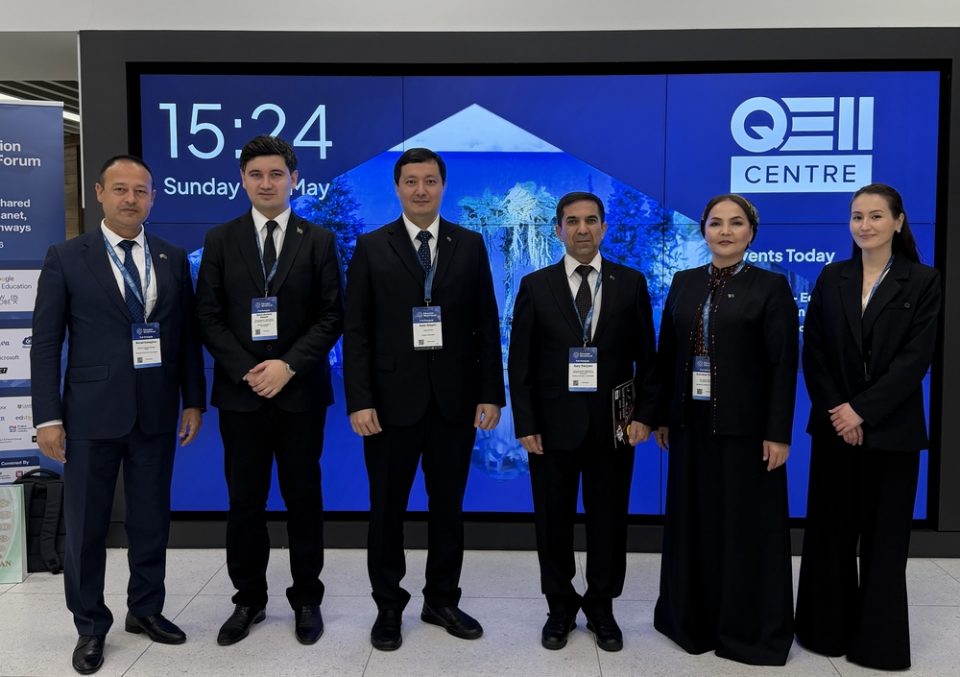
From 17 to 21 May 2026, a delegation of the Ministry of Education of Turkmenistan, headed by Deputy Minister of Education of Turkmenistan Azat Atayev, is participating in the Education World Forum 2026 in London — one of the leading international platforms for discussing education policy, digital transformation, human capital development and the introduction of innovation into education systems.
The first events of the Forum took place at the Park Plaza London Westminster Bridge hotel, where ministerial initiatives and expert discussions were held. During a high-level session organised by the OECD, Cambridge University Press & Assessment and the Learning Planet Institute, the Turkmen delegation presented the work being carried out in the country to integrate the principles of climate resilience and environmental education into the national education system. Particular attention was paid to the implementation of the National Climate Plan, the development of the Green School pilot project, and cooperation with UNICEF on the introduction of modern STEM approaches and adaptive educational tools.
Following the opening of the Forum, the delegation continued its work at the Queen Elizabeth II Centre. Representatives of Turkmenistan took part in the specialised seminar “From Vision to Reality: Advancing Education Systems with Apple,” dedicated to scalable digital transformation, the development of leadership in education, the training of pedagogical and IT personnel, and the creation of a sustainable digital educational environment.
During a series of bilateral meetings, the Turkmen side presented the work being carried out under the leadership of the esteemed President of Turkmenistan, Serdar Berdimuhamedov, to modernise the national education system. Concrete results reflecting the growth of the quality of education and scientific activity were highlighted, including the introduction of a management KPI system for higher education institutions comprising more than 80 indicators; the growth of publication activity by higher education institutions; the increase in citation of scientific works; the development of centres for the commercialisation of scientific research; and the expansion of digital platforms that enable data-driven management decisions. The provisions of the Strategy for the Development of Higher Education of Turkmenistan for 2026–2052 and the Atlas of Future Professions were also presented.
At a meeting with representatives of Classera, the company’s educational portfolio, AI-based digital solutions, analytical tools and opportunities for integrating educational data to form individual learning pathways were discussed. The Turkmen side presented approaches being implemented within national digital solutions, including the eMekdep platform. The parties agreed to consider a small pilot format for cooperation in analytics, personalised learning and teacher support.
With representatives of ClassLink, the discussions focused on the integration of educational data, management of access to digital resources, analytics on the use of educational platforms, and the development of management dashboards for schools and education authorities. It was noted that these approaches are in line with Turkmenistan’s work to develop digital education infrastructure and increase the transparency of management decisions.
During a meeting with Times Higher Education, the parties discussed international university rankings, assessment methodology, the presentation of reliable data on Turkmen higher education institutions, and ways to increase their international visibility. THE representatives highly appreciated the work being carried out by Turkmenistan to develop higher education, increase scientific activity and introduce KPI-based approaches. The parties discussed the possibility of selecting one pilot higher education institution for systematic work to improve its international competitiveness and gradually advance toward participation in the most authoritative global rankings.
Special attention was paid to cooperation with Pearson. During the discussion, it was emphasised that international certification in digital and professional skills can become an important tool for increasing the competitiveness of students, teachers and young professionals. The parties considered issues related to the establishment of certification centres, the introduction of internationally recognised qualifications, and the formation of a sustainable model of access to professional tests and certification programmes.
At a meeting with representatives of Educational Testing Service (ETS), the parties discussed international experience in educational measurement, standardised testing, transparent procedures for assessing learning outcomes, and the training of specialists in testology and psychometrics. ETS is an internationally recognised organisation in the field of educational testing and assessment, including such widely known examinations as TOEFL, GRE, TOEIC and Praxis.
During negotiations with the Project Management Institute, the parties discussed the development of project management in the education system. The Turkmen side noted that the effective implementation of strategies and reforms requires not only concepts and programmes, but also management tools: project offices, roadmaps, indicators, risk monitoring and implementation control. As a practical continuation, the possibility of holding an introductory seminar on the management of education reforms and digital projects was proposed.
With representatives of Matific, the parties discussed the possibilities of applying artificial intelligence in mathematics teaching. Particular interest was shown in solutions where AI can perform the functions of a personal tutor, helping students master material at an individual pace while enabling teachers to receive data on students’ progress, difficulties and learning needs. The parties discussed the possibility of a small pilot aimed at diagnosing and supporting students’ mathematical preparation.
During meetings with the British Council, the outcomes and future prospects of the AELLCA — Accelerating English Language Learning in Central Asia — project were reviewed. The Turkmen side expressed appreciation for the stages already implemented, through which a significant number of English language teachers and methodologists were able to become familiar with modern approaches to teaching. The active role of Nottingham Trent University, NILE — Norwich Institute for Language Education, the University of Westminster, as well as the Turkmen partners — the International University for the Humanities and Development, the Dovletmammet Azadi Turkmen National Institute of World Languages and the National Institute of Education — was noted. It was emphasised that the potential of AELLCA can be used as an accelerator for broader interaction between Turkmenistan and the United Kingdom in education, including teacher training, teaching methodology, IELTS, English for Academic Purposes and the development of inclusive approaches.
Discussions were also held on the ethical and safe use of artificial intelligence in education. During the sessions, it was emphasised that AI should be used for the benefit of the educational process: to support teachers, assist students, strengthen individual learning pathways, generate objective analytics, and at the same time comply with requirements for transparency, data protection and pedagogical responsibility.