
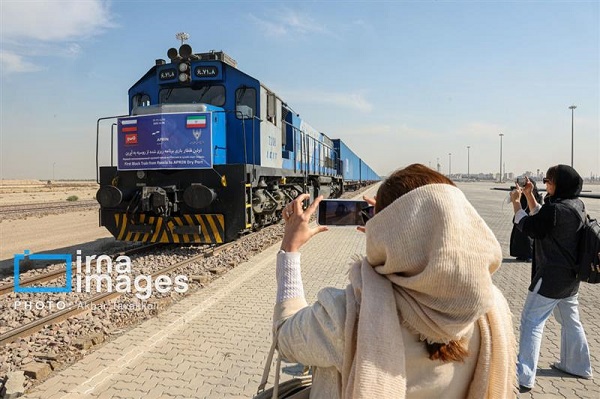
On 8 November 2025, a milestone unfolded in the sphere of Eurasian trade when the first scheduled freight train from Russia pulled into Iran’s Aprin dry port, right on the outskirts of Tehran.
This wasn’t some random shipment; it was a carefully coordinated effort that had been in the works to strengthen ties between Moscow and Tehran, especially amid ongoing global tensions and sanctions.
The train, originating from the Arkhangelsk region about 900 kilometers north of Moscow—a hub for pulp and paper production—carried 62 forty-foot containers loaded with paper products, pulp, and related goods. These were destined not just for markets in Iran but also for onward distribution to Iraq, highlighting how this route is already thinking beyond borders.
The whole journey spanned over 4,000 kilometers and took about 12 days, weaving through Russia, Kazakhstan, Turkmenistan, and finally into Iran via the Incheh Borun border crossing before chugging the last 640 kilometers or so by rail to Aprin.
What makes this particularly interesting is the route itself, part of the eastern branch of the International North-South Transport Corridor, or INSTC for short. In Russia, the train covered roughly 2,500 kilometers of track from its starting point down to the Kazakh border near Ganyushkino. Then it crossed about 430 kilometers through Kazakhstan, passing spots like Atyrau and Uzen, before entering Turkmenistan for another 470 kilometers via Bereket and Etrek to the Iranian border at Incheh Borun. Once in Iran, it followed the existing rail network—electrified in parts—for those final 640 kilometers through Gorgan, Garmsar, and Tehran to reach Aprin.
There were gauge changes at the borders since Russia, Kazakhstan, and Turkmenistan use a broader 1,520 mm gauge, while Iran sticks to the standard 1,435 mm, but that’s all part of the logistics that got ironed out by railways, customs, and entities across the four countries.
This isn’t meant to be a one-time spectacle; plans are in place to make it a regular service, starting with one train every 10 days and ramping up from there as trade expands along the INSTC. It’s a practical step toward boosting economic cooperation, especially for Russia and Iran, in finding alternative pathways that sidestep traditional routes like the Suez Canal.
Interestingly, this follows a similar move by China, which sent its inaugural train to the same Aprin port back in May 2025, underscoring how BRICS nations are deepening their integration through these corridors, even if the cargoes so far are mostly commercial staples like paper rather than anything more strategic.
Yrain route holds tremendous potential for cargo movement not just among Russia, Kazakhstan, Turkmenistan, and Iran, but for a whole web of neighboring countries that could tap into it. For starters, within these four, it streamlines the flow of goods like energy resources, agricultural products, and manufactured items—such as think Russian timber and minerals heading south, or Iranian petrochemicals and Kazakh grains moving north.
The INSTC’s eastern branch cuts transit times and costs significantly compared to sea routes, potentially handling up to 50 million tons of cargo annually once fully optimized.