
I would like to start with a quote by Rita Mae Brown: “Language is the road map of a culture. It tells you where its people come from and where they are going.” Words are among the most powerful tools we possess. They are how we name the world, how we reach across the distance between one mind and another, and how we preserve the memory of who we are. A single word, learned in a language not your own, can unlock a door you did not know existed: a door to a friendship, to an opportunity, to an entirely new way of understanding the world. The Turkmen people have long understood this. There is a Turkmen proverb that says, “Studying is as difficult as digging a grave with a needle,” a vivid reminder that the pursuit of knowledge demands patience and perseverance. But what the proverb leaves unsaid is equally true: the reward of that labor is immeasurable. A dictionary, then, is not merely a book of definitions. It is a book of doors.
I write these words as someone for whom one such door opened more than a decade ago, unexpectedly, in a place I had never planned to go, and never fully closed again.
In 2013, I went on a yearlong program as an undergraduate studying abroad in Central Asia, based in Kyrgyzstan, for the final year of my studies. As someone originally from Alaska, I have always been drawn to vast, open landscapes, and it was that same pull toward open spaces (along with a desire to experience somewhere completely different) that first drew me to Central Asia’s steppes and deserts. During the program I had the opportunity to travel around the region, and my interest gradually focused on Turkmenistan, which is why I added the Turkmen language to my course list. My tutor did far more than teach me grammar. Through cultural presentations on Turkmen art, history, and heritage, he opened a window into an entire civilization. He was, in his own way, practicing what the Turkmen have valued for centuries: the tradition of the mugallym, the teacher who transmits not only knowledge but also terbiýe or moral upbringing, cultural formation, and a sense of one’s place in the world. In 2014, I finally had the chance to travel through Turkmenistan itself for almost two weeks. The landscapes, the architecture, and the extraordinary hospitality of the Turkmen people left an impression that has never faded.
What I did not expect was that Turkmenistan would keep finding its way back to me, again and again, for over eleven years, as if the connection was somehow meant to be. In 2015, I served as a Delegation Liaison for the Turkmen Special Olympics Team during the World Games in Los Angeles, an experience that deepened my understanding of cross-cultural diplomacy and the positive impact sports can have on individuals worldwide. In 2016, the very first university friend I met at the start of my Master’s program happened, against all probability, to be Turkmen, and this connection proved invaluable for my thesis research on “Researches on the Influence of Turkic Cultural Dimensions in International Business Development.” In 2019, United Nations Volunteers assigned me to research and collect data on Turkmenistan’s digital public services for the UN E-Government Survey. In 2021, my Turkmen university friend invited me to a Turkmenistan government-sponsored cultural exhibition held, coincidentally, in the very city where I was living at the time. In 2024, while serving as a Peace Corps Volunteer in Mongolia, the President of Mongolia made a state visit to Turkmenistan, a moment that felt, in hindsight, like foreshadowing. And in 2025, I became the Country Director for American Councils for International Education in Turkmenistan, overseeing programs and partnerships across the country. During that time, I even had the chance to reconnect with a trainer in the city of Mary whom I had worked with a decade earlier at the 2015 Special Olympics.
I share this story not because it is extraordinary, but because it illustrates something that anyone who has learned a second language will recognize: once you begin to engage with a culture through its language, you set in motion a chain of connections that can shape the entire course of your life. The Turkmen say, “Damja-damja köl bolar”: drop by drop, a lake is formed. Every encounter I have described above was a single drop, made possible by the fact that I had taken the time to learn even a little Turkmen in order to connect to its people. Language was the thread that wove these experiences together into something far larger than any one of them. The Turkmen language is a treasure that deserves far greater recognition in the world. A Turkic language with deep roots in Central Asian history, it carries within it centuries of poetry, oral tradition, and the collective wisdom of the Turkmen people. The Turkmen concept of Türkmenchilik, a word that has no simple English equivalent but which captures the deep pride Turkmen hold in their culture, identity, and way of life, is inseparable from the language that expresses it. To speak Turkmen is to participate in Türkmenchilik; to understand its idioms and proverbs is to glimpse the moral and philosophical world that has sustained the Turkmen people across centuries.
At the heart of this tradition stands Magtymguly Pyragy, the great eighteenth-century poet, philosopher, and Sufi thinker who is revered as the father of Turkmen literature. Magtymguly was himself the product of a culture that prized education. The son of the poet and scholar Döwletmämmet Azady, he studied at madrassahs in Turkmenistan, Khiva, and Bukhara before spending much of his life as an itinerant teacher and spiritual guide. His approximately eight hundred poems, composed in Turkmen at a time when Persian was the dominant literary language of the region, were a revolutionary act of cultural assertion. They are still recited today, often quoted as proverbs in daily life, and adapted into song by bakhshys, the traditional Turkmen singer-storytellers who have carried the oral tradition forward across generations. Magtymguly’s legacy embodies a principle that Turkmen education has always held sacred: that knowledge is not merely intellectual but deeply moral, and that the purpose of learning is to cultivate not just a sharp mind but a worthy character. In 2024, UNESCO and the International Organization of Turkic Culture (TURKSOY) jointly commemorated the 300th anniversary of his birth, affirming his significance not only to Turkmenistan but to world literature.
Yet for all its richness, Turkmen has historically been underserved by comprehensive bilingual reference works. Outside of Turkmenistan, opportunities to study the language remain limited. Victoria Clement’s groundbreaking 2018 book, Learning to Become Turkmen, the first book in a Western language to draw on Turkmen archives, brought to light how central language and literacy have been to Turkmen identity over the past century. The Turkmen consciously used language and pedagogy to position themselves within global communities, from the Russian Empire to the Turkic cultural world to the broader Muslim world. But scholars, diplomats, and students who wish to engage with Turkmen today have often had to rely on scattered or incomplete resources. The need for an authoritative, accessible bridge between English and Turkmen has never been greater.
This is precisely why the work you hold in your hands matters so profoundly. The Makul English-Turkmen Dictionary and this companion Language Handbook represent something rare: a rigorous, accessible, and lovingly assembled resource that bridges two linguistic worlds. Dr. Dovran Orazgylyjov and this great editorial team which I am a part of have undertaken a project that is at once deeply practical and deeply meaningful. For the student of English in Ashgabat, this is a reliable guide to mastering a global language. For the Turkmen professional in the diaspora, it is a link to the mother tongue. For the international scholar, diplomat, or development worker (people like me), it is an indispensable tool for genuine engagement with Turkmen culture. And for future generations, it is an act of preservation: a record that ensures this beautiful language will not only survive in the digital age but thrive in it.
To anyone considering the study of a new language, especially one that may seem unfamiliar or distant, I offer this encouragement: begin. You do not need to achieve perfection. You need only to take the first step, and a resource like this one will carry you further than you imagine. I know this from experience. A single decision to learn a few words of Turkmen out of curiosity set into motion eleven years of encounters, friendships, and professional achievements that I could never have predicted. Language learning is not just an intellectual exercise. It is an act of respect, of curiosity, and of faith that the world is wider and more interesting than what we already know. And in the Turkmen tradition, it is something more still: it is a path toward edep, the cultivation of refinement, good manners, and moral grace that comes from genuinely seeking to understand another people on their own terms.
And to you, the reader: thank you for picking up this book. Whether you are a student, a professional, a scholar, or simply someone whose curiosity led you here, know that by opening these pages you have already taken the most important step. Your journey in language learning is not ahead of you somewhere in the distance- it is here. It is beginning right now, in this moment, with this decision. The fact that you are holding this book tells me something about you: that you believe, as I do, that understanding another language and another culture is worth the effort. You are right, and you are in excellent hands.
There is a saying often attributed to Nelson Mandela: “If you talk to a man in a language he understands, that goes to his head. If you talk to him in his language, that goes to his heart.” This book is, in the most literal sense, a guide to reaching the heart. It stands in a long and honorable line of works, from the madrassah scholars who first taught Magtymguly, to the bakhshys who carried Turkmen poetry across the steppe, to the modern educators and linguists who are ensuring that the Turkmen language flourishes in a new century. I am honored to introduce it, and I have no doubt that the next unexpected Turkmen encounter, for me and perhaps for you as well, is just around the corner.
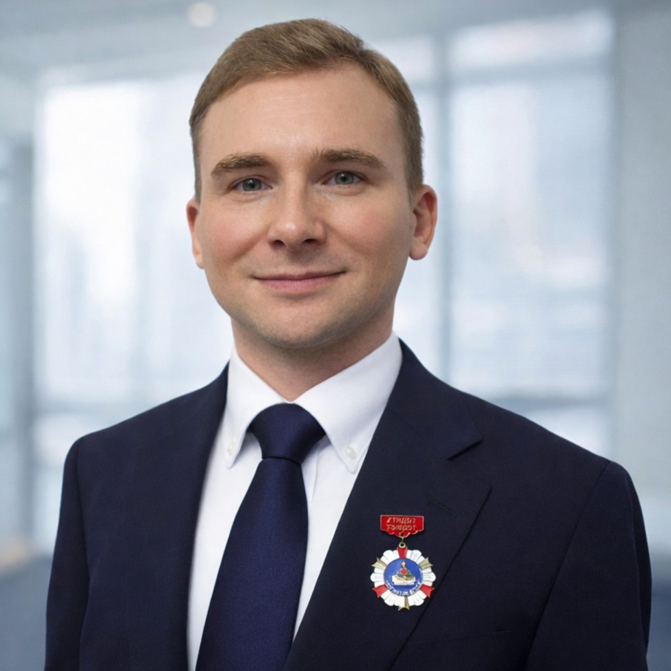
Christopher Wizda
Educator & International Development Professional
Ulaanbaatar, Mongolia, 2026
linkedin.com/in/christopher-
Christopher Wizda is an educator and international development professional with over a decade of experience across Kyrgyzstan, Mongolia, Russia, Turkmenistan, and the Circumpolar North. His work spans non-governmental organizations, United Nations, and government-adjacent sectors, where he has led multidisciplinary teams and delivered programs advancing institutional strengthening, capacity building, and community development. He holds a Master of Science in Management from Peter the Great St. Petersburg Polytechnic University in Russia, a Bachelor of Arts in Northern Studies from the University of Alaska Fairbanks, and an Associate of Arts in International Studies from Northern Virginia Community College. His professional credentials include business intelligence, monitoring and evaluation, and project management. He has authored articles on trade, climate, and cultural topics across Eurasia, and has contributed to technical reports and policy documents for UNICEF, UNDP, UN DESA, and other international organizations. He is currently a member of the Association for Slavic, East European, and Eurasian Studies (ASEEES) and the Inter-Agency Network for Education in Emergencies (INEE) Minimum Standards Working Group. Fluent in Russian and experienced in Mongolian, Slovak, and Turkmen, he leverages his linguistic and cultural expertise to build partnerships and opportunities. He currently teaches business management, conducts research on Turkmenistan and Turkmen culture, and serves as a freelance consultant.